Up to now I've built the Void mostly for myself — the crash-test pilot of my own digital life, hacking at the experiences that cause me the most pain and rebuilding my environment one piece at a time. It started as a solitary mission to reclaim my own human–computer interaction.
Hittills har jag byggt Void mest för mig själv — krocktestpiloten i mitt eget digitala liv, som hackar på de upplevelser som gör mest ont och bygger om min miljö en bit i taget. Det började som ett ensamt uppdrag att återerövra min egen interaktion mellan människa och dator.
But the natural extension of this architecture — the thing that makes it genuinely transformative — is putting collaboration at the absolute core. Which brings us back to Engelbart's real goal: boosting our collective IQ, building a shared intellectual space.
Men den naturliga förlängningen av den här arkitekturen — det som gör den genuint omvälvande — är att sätta samarbete i den absoluta kärnan. Vilket för oss tillbaka till Engelbarts egentliga mål: att höja vårt kollektiva IQ, att bygga ett gemensamt intellektuellt rum.
Because Void rests on an event bus rather than buttons wired straight to functions, “multiplayer” doesn't have to be an awkward bolt-on or a glorified screen-share — it falls out of the design. I've prototyped only small pieces of this collaborative layer so far; the rest is the part I'm most excited to reach. Here's what it could look like:
Eftersom Void vilar på en händelsebuss snarare än knappar kopplade rakt till funktioner behöver ”multiplayer” inte vara ett klumpigt tillägg eller en uppblåst skärmdelning — det faller ut ur designen. Jag har bara prototypat små delar av det här samarbetslagret hittills; resten är den del jag är mest taggad att nå. Så här skulle det kunna se ut:
- For code: with CRDTs (conflict-free replicated data types), the codebase itself could become a shared, living state. Multiple developers inhabiting one workspace; changes propagating instantly, with no files and no merge conflicts.
- For knowledge: the Knowledge Web becoming a multi-user world — zoom out and watch where collaborators are exploring in real time, connections lighting up across the globe as they're forged.
- Radical individuality, still: want to test a wild idea? Opt out of the shared master state, branch into your own private runtime, experiment safely — then selectively pull others' changes in, or push your invention back to the collective.
- För kod: med CRDT:er (konfliktfria replikerade datatyper) skulle själva kodbasen kunna bli ett gemensamt, levande tillstånd. Flera utvecklare som bebor en och samma arbetsyta; ändringar som sprids direkt, utan filer och utan merge-konflikter.
- För kunskap: Kunskapsväven som blir en värld för många användare — zooma ut och se var medarbetarna utforskar i realtid, kopplingar som tänds över hela världen i samma stund som de knyts.
- Radikal individualitet, ändå: vill du testa en vild idé? Kliv ur det gemensamma huvudtillståndet, grena av till din egen privata körmiljö, experimentera tryggt — och dra sedan selektivt in andras ändringar, eller skjut tillbaka din uppfinning till kollektivet.
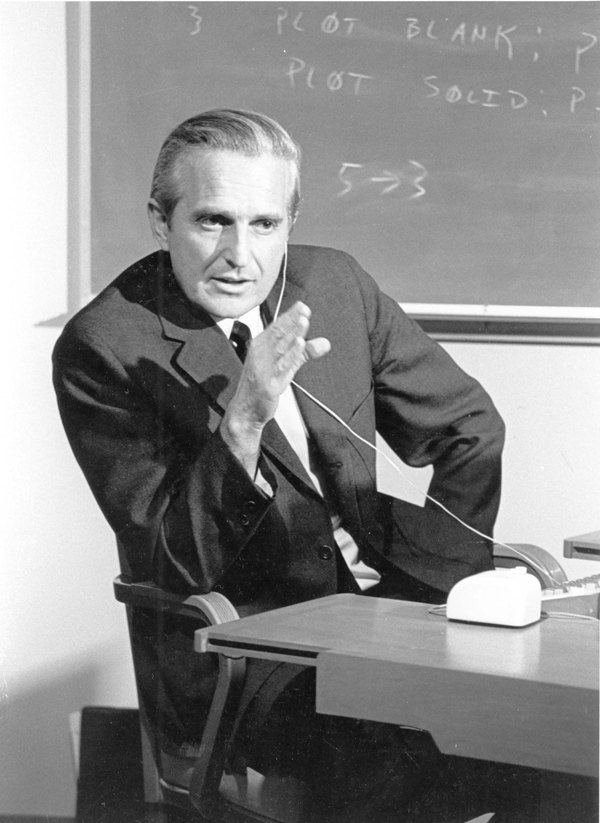
I started this journey to fix how I interact with my devices — with technology itself. But the destination is a fluid, moldable environment where communities can weave ideas, interfaces, and knowledge together — and augment human intellect in real time. The same thing Engelbart was pointing at, from behind that headset, in 1968.
Jag gav mig ut på den här resan för att fixa hur jag interagerar med mina enheter — med tekniken själv. Men målet är en flytande, formbar miljö där gemenskaper kan väva samman idéer, gränssnitt och kunskap — och förstärka det mänskliga intellektet i realtid. Samma sak som Engelbart pekade mot, bakom det där headsetet, 1968.